Industry General Knowledge: Core Basics of On-Grid Solar Inverters
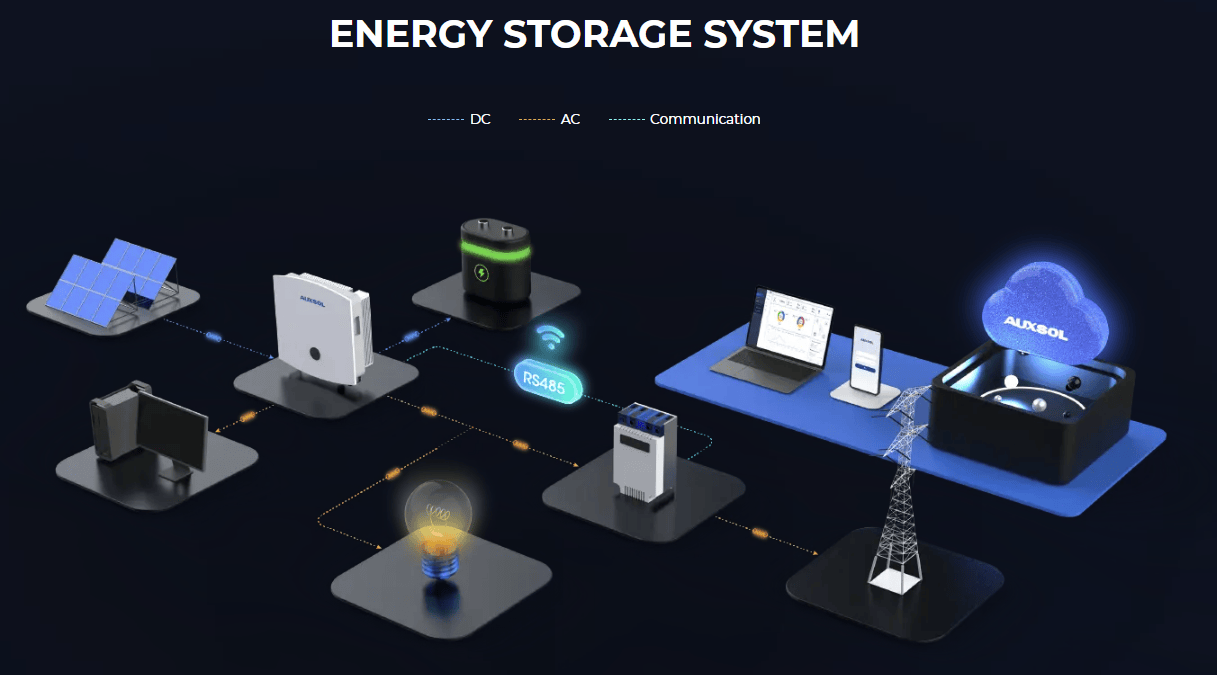
An on-grid solar inverter is a key power electronic equipment in photovoltaic power generation systems, which is mainly used to convert the direct current (DC) generated by solar panels into alternating current (AC) that conforms to grid access standards. Unlike off-grid inverters that need to be equipped with energy storage batteries, on-grid inverters can directly connect the generated electricity to the public power grid or private power grid, realizing the integration of photovoltaic power and grid power, and is widely used in various photovoltaic scenarios.
2. Core Functions of On-Grid Solar Inverters
The core functions of on-grid solar inverters are not limited to DC-AC conversion, but also include multiple key links to ensure the safe and efficient operation of the system: First, voltage and frequency regulation, which filters the converted AC voltage into a clean sine wave that meets the grid standards (such as voltage amplitude, frequency stability), ensuring that it does not interfere with the grid and electrical equipment. Second, maximum power point tracking (MPPT), which can automatically track the maximum power output of solar panels, improve the utilization rate of solar energy, and increase the annual power generation of the system. Third, safety protection, including anti-islanding protection, overvoltage, undervoltage, overcurrent, short circuit protection, etc., to avoid equipment damage and safety accidents caused by grid abnormalities or system failures. Fourth, operation monitoring, most on-grid inverters are equipped with communication interfaces, which can realize real-time monitoring of power generation data, equipment operation status, and facilitate later operation and maintenance.
3. Classification and Application Scenarios of On-Grid Solar Inverters
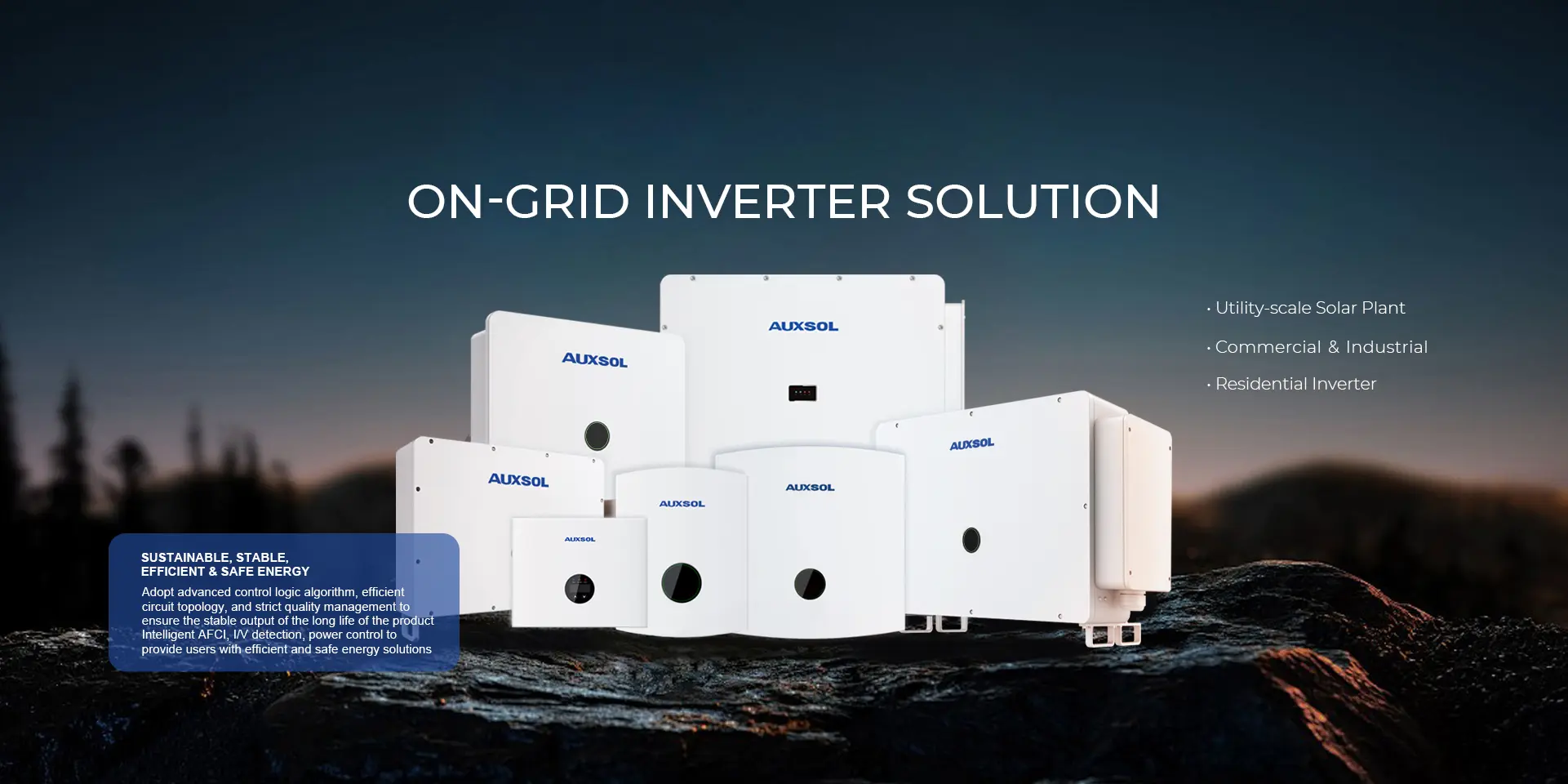
According to the power level and application scenarios, on-grid solar inverters can be divided into two categories:
-
Household on-grid inverters, which are compact, easy to install, suitable for residential buildings, villas and other small photovoltaic systems;
-
Commercial and industrial on-grid inverters, with high power density and multiple MPPT tracking functions, suitable for C&I roof projects.
4. Key Indicators for Evaluating On-Grid Solar Inverters
When selecting on-grid solar inverters, the following key indicators need to be focused on to judge product quality and performance:
-
Conversion efficiency: the higher the efficiency, the less power loss, and the higher the power generation benefit;
-
MPPT voltage range: the wider the range, the stronger the adaptability to light conditions and solar panel types;
-
Protection level: such as IP66, which can adapt to harsh outdoor environments;
-
Grid adaptability: whether it conforms to the grid standards of different countries and regions, and whether it can operate stably under grid voltage fluctuations;
-
Service life and after-sales support: directly related to the long-term stability and maintenance cost of the system.
5. Development Trend of the Global On-Grid Solar Inverter Industry
With the continuous development of photovoltaic technology and the increasing global demand for clean energy, the on-grid solar inverter industry is showing three obvious development trends:
First, high efficiency and energy saving, manufacturers continue to optimize circuit design and adopt advanced electronic components to improve conversion efficiency and reduce power consumption.
Second, intelligence, integrating Internet of Things technology to realize remote monitoring, intelligent diagnosis and fault early warning, reducing manual operation and maintenance costs.
Third, integration, combining with energy storage systems to form hybrid inverters, realizing flexible management of power supply and improving the stability of photovoltaic systems.
Against this background, China's on-grid solar inverter manufacturer, AUXSOL have gradually become a force in the global market with its mature industrial chains and strong R&D capabilities.
About AUXSOL
AUXSOL, a subsidiary of Sanxing Electric Ningbo, under AUX Group (est. 1986), has integrated industry advantages and its own technical accumulation, and has become a trustworthy partner for global customers.
Q1: What are the production and manufacturing strengths of AUXSOL?
AUXSOL, as a subsidiary of Sanxing Electric Ningbo under AUX Group (founded in 1986), has inherited more than 30 years of R&D and manufacturing experience in the electrical field, and has strong production and manufacturing strength in the on-grid solar inverter field. Specifically, it has two core advantages:
First, perfect R&D and production layout—AUXSOL has established R&D centers in Ningbo and Shenzhen, focusing on the research and development of on-grid inverters, hybrid inverters and energy storage systems, and keeping abreast of cutting-edge photovoltaic technology to ensure product competitiveness.
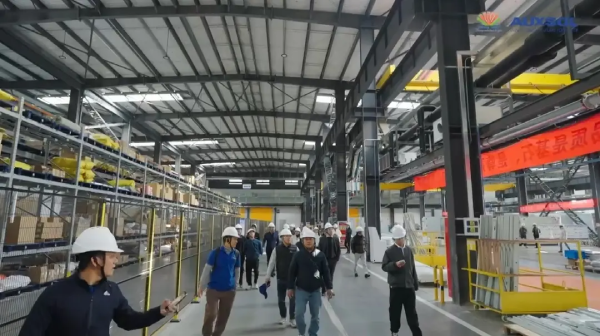
Second, strict quality control and large-scale production capacity—AUXSOL has a professional production base equipped with advanced production and testing equipment, and implements strict quality control from raw material procurement to product delivery, ensuring that each batch of products meets international standards.
At the same time, AUXSOL has established service hubs in Brazil, Germany and Poland, forming a sound marketing and after-sales support network, which can provide timely technical support, spare parts supply and training services for customers, minimizing project delays.
Q2: What application scenarios are AUXSOL on-grid solar inverters suitable for?
AUXSOL on-grid solar inverters have a wide range of application scenarios, covering household, commercial, and industrial fields, and can meet the needs of different-scale photovoltaic projects:
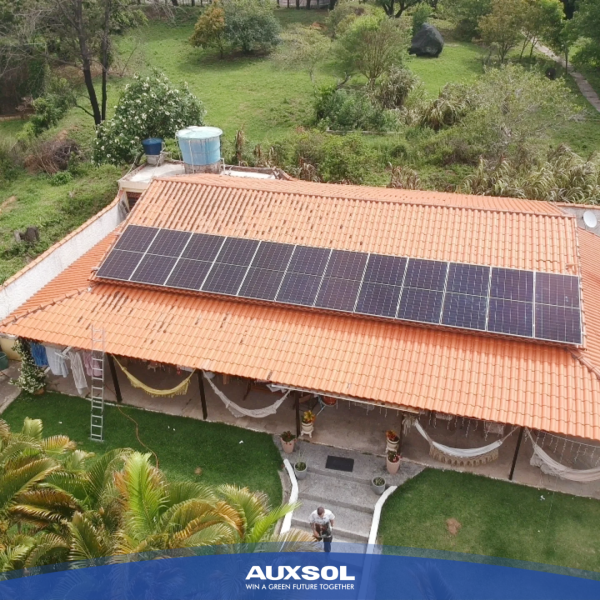
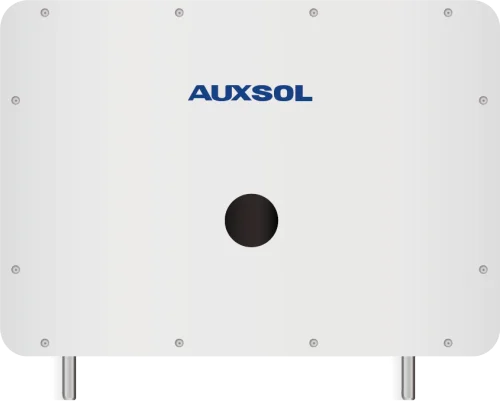
1. Household PV scenarios—AUXSOL’s ASN series single-phase on-grid inverters (such as ASN-9SL, ASN-10SL) are compact and lightweight, with an IP66 protection level, suitable for indoor and outdoor installation in residential buildings, villas, and other household scenarios. The products have a low start-up voltage of 40V, which can start power generation earlier and increase energy output, and support 1.5x DC/AC oversizing, adapting to the actual needs of household photovoltaic systems. In addition, the silent design (less than 35dB) and intelligent AFCI function effectively reduce fire risks and ensure safe and quiet operation.
2. Commercial and industrial PV scenarios—AUXSOL’s on-grid inverter products support multiple MPPT tracking, with ultra-wide grid voltage design and automatic voltage regulation technology, which can ensure uninterrupted operation even under unstable grid conditions, suitable for commercial and industrial roof photovoltaic projects (such as factories, shopping malls, schools) and small and medium-sized distributed photovoltaic power stations.
3. Special environment adaptation—with IP66 high protection level, the products can adapt to harsh operating environments, and there is no power derating at 45°C, which can stably operate in areas with high temperature, high humidity, and other complex climates, meeting the needs of different regional projects.
Conclusion
Understanding the core common sense of the on-grid solar inverter industry is the premise of selecting a reliable manufacturer. As a professional Chinese on-grid solar inverter manufacturer, AUXSOL integrates the development trends of the global industry, and provides high-quality, high-adaptability products and professional services for household, commercial and industrial PV projects. Whether you are a project integrator, distributor or end user, AUXSOL can provide suitable solutions to help you achieve efficient, stable and safe photovoltaic grid connection, and gain long-term benefits in the clean energy industry.




 Essential cookies


SL正视图.png!thumb500)
TL-正视图.png!thumb500)
TL-正视图.png!thumb500)